

Table of Contents
- Why Fuller Lashes and Brows Change Your Look
- The Best Eyebrow Growth Serum: What Separates Hype From Results
- Eyelash Serum Safety: What You Need to Know Before You Apply
- How to Make Eyebrows Look Fuller Without Overdoing It
- Your Lash and Brow Care Routine: Steps for Nightly Consistency
- Lash Lift, Brow Lamination, and When to Choose Professional Help
- Conclusion: Building a Gentle, Lasting Approach
- Frequently Asked Questions
Last Updated: October 7, 2026
Why Fuller Lashes and Brows Change Your Look
Fuller lashes and brows do more for your face than most makeup tricks ever will. They frame your eyes, add definition, and make you look awake even on low-sleep days.
At Sacred Space Self-Care, we see this shift all the time. Women want growth that looks natural, not painted on. They want brows that hold their shape and lashes that stop snapping mid-week.
Here is the honest truth: no serum works overnight. But a simple, consistent routine can help support the look you want.
The Best Eyebrow Growth Serum: What Separates Hype From Results
The best eyebrow growth serum is not the one with the longest ingredient list. It is the one you will actually use every night. Consistency beats complexity, every time.

So what should you look for?
- Simple formulas. Fewer ingredients mean less chance of irritation.
- Nourishing oils. Castor oil is a classic for a reason. It coats and conditions brows so they look healthier over time.
- A precision applicator. You need to reach the root, not smear your whole brow bone.
- No harsh additives. Skip anything with synthetic fragrance or fillers.
Many women find that a single-ingredient oil works better than a complicated serum. Fewer variables, fewer reactions.
Eyelash Serum Safety: What You Need to Know Before You Apply
Eyelash serum safety comes down to three things: what is in the bottle, how you apply it, and how long you use it. Get any of the three wrong and you risk irritation, redness, brittle lashes, or, with one specific ingredient class, changes that outlast the product itself.
The eye area is delicate. The FDA guidance on cosmetic safety reminds consumers that cosmetics applied near the eyes deserve extra care, especially for anyone with sensitive eyes. That is not a marketing line.
The ingredient class that deserves the most caution
The formulas most often flagged by dermatologists are those built on prostaglandin analogs, ingredients such as bimatoprost, isopropyl cloprostenate, and dechloro dihydroxy difluoro ethylcloprostenolamide. These began as prescription glaucoma medications, where a side effect of longer, darker lashes was noticed and later commercialized for cosmetic use.
What practitioners commonly report with prostaglandin analogs:
- Irritation and redness along the lash line, sometimes within the first week
- Darkening of the eyelid skin (hyperpigmentation) that can persist after you stop
- Periorbital fat loss, a hollowed look around the eye, in a subset of users, which is the change most often described as difficult to reverse
- Iris color changes in rare cases, which is why these ingredients are prescription-only in ophthalmic form
If you have sensitive eyes, a history of stinging with eye makeup, dry eye, or you wear contacts, prostaglandin-free formulas are the gentler route. They work more slowly, think weeks to months rather than days, but they tend to suit sensitive eyes far better.
Ingredients to screen for on the label
Read the full ingredient list, not the front of the box. A few categories worth knowing:
- Conditioning oils, castor oil, jojoba, argan, squalane. These coat and condition the hair you already have. They do not change the growth cycle.
- Peptides, copper peptides and biotinoyl tripeptide-1 appear in many non-prostaglandin serums. Evidence is modest but they are generally well tolerated.
- Biotin and panthenol, common, low-risk, mostly supportive.
- Preservatives and fragrance, phenoxyethanol is common and usually fine; synthetic fragrance and some parabens are the more frequent irritants near the eye.
Application rules that actually reduce risk
- Patch test on your inner wrist for two nights before using anything near your eyes.
- Use one drop or one swipe per eye. More product does not mean faster results; it means more migration into the eye.
- Never share an applicator. Bacteria travels fast, and the lash line is not the place to find out.
- Apply to the upper lash line only, at the base of the lashes, not on the lower lid and not on the waterline.
- Stop if you notice stinging, swelling, or redness that does not fade within a day or two.
- Do not layer a new serum with a new lash lift in the same week. If something irritates your eye, you will not know which one caused it.
A note on the long game
Safety is not just about the first application. Prostaglandin analogs are the class most associated with effects that linger after you stop, which is why the at-home conditioning route, oils, peptides, consistent nightly use, remains the lower-risk default for most people who simply want fuller-looking lashes and brows over time.
How to Make Eyebrows Look Fuller Without Overdoing It
Knowing how to make eyebrows look fuller is mostly about restraint. Overfilled brows look drawn on. Natural fullness comes from conditioning and shape, not from product piled on top.
Start with the hair you already have. A nightly conditioning treatment helps brows look thicker and less patchy over time.
Then work on shape:
- Brush brows upward with a spoolie before bed.
- Fill only the sparse spots, not the whole brow.
- Use a tinted gel instead of a pencil for a softer finish.
- Leave the front of the brow lighter. It looks more natural.
Structured brows come from good grooming, not heavy product. A little definition goes a long way.
Your Lash and Brow Care Routine: Steps for Nightly Consistency
A lash and brow care routine only works if it is short enough to repeat. Ours takes under two minutes.
Night Growth Serum for Brows & Lashes 100% Castor Oil →
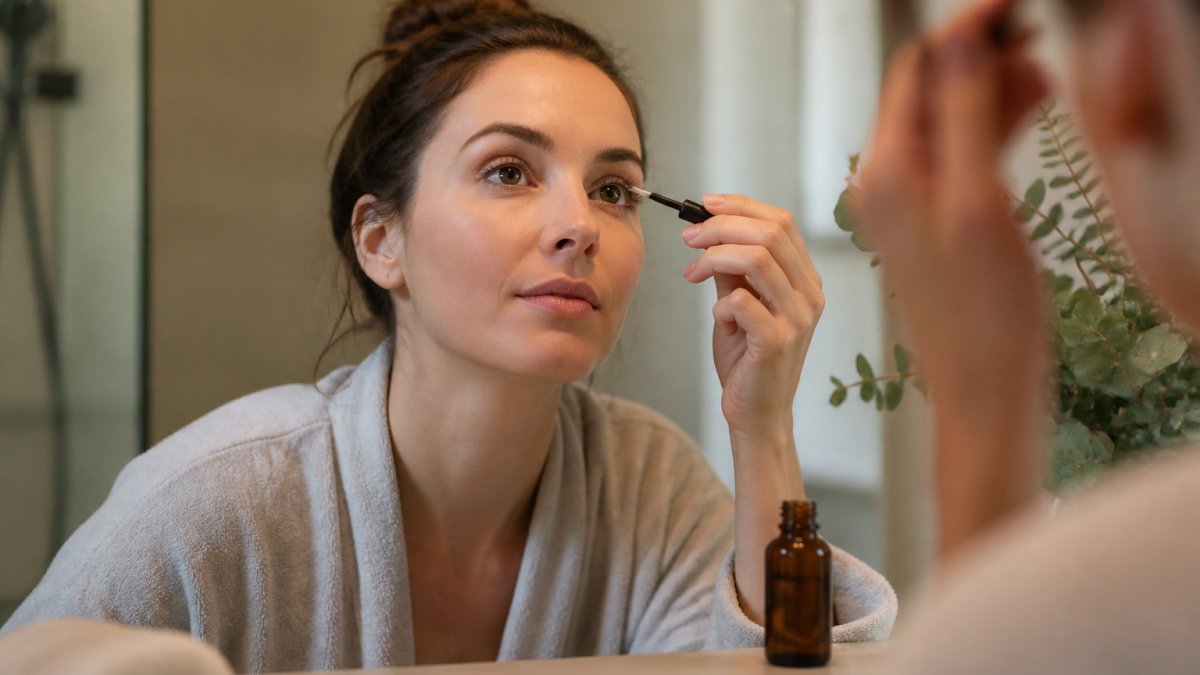
Here is the sequence we recommend:
- Cleanse your face and pat the eye area dry.
- Sweep a small amount of serum along the upper lash line.
- Coat each brow with the same wand, root to tip.
- Brush brows into shape with a clean spoolie.
- Leave it on overnight. Rinse in the morning.
That is it. No ten-step ritual, no guesswork.
Our Night Growth Serum for Brows & Lashes is built for exactly this. It uses 100% organic castor oil, one clean ingredient, with a precision applicator for targeted use.
Lash Lift, Brow Lamination, and When to Choose Professional Help
Professional treatments have their place, but they solve a different problem than a serum does, and understanding that difference is what keeps you from wasting money or damaging hair.
What each treatment actually does
A lash lift chemically breaks and reforms the disulfide bonds in your natural lashes, curling them upward from the base. It does not add length or density. It changes the angle, which makes the lashes you already have read as longer and more open-eyed.
Brow lamination does the same thing to brow hairs, it relaxes the bond structure so hairs lie flat and fan upward, filling in sparse areas visually. Results typically last four to six weeks, less if you have oily skin or use active skincare near the brow.
Both are cosmetic rearrangements. Neither one grows a single new hair.
The mechanism behind the risk
The active step in both treatments is a chemical relaxing solution, usually ammonium thioglycolate at an alkaline pH, followed by a neutralizer to rebuild the bonds. That chemistry is the same family used in hair relaxers, and it is why the eye area deserves caution:
- Thioglycolate burns if it contacts the eye or sits too long on skin.
- Over-processing, leaving the solution on too long, or repeating treatments too close together, weakens the hair shaft and causes breakage. A brow that snaps mid-shaft will not grow back faster than its normal cycle allows.
- Sensitive or reactive skin can develop contact dermatitis from the solution or the tint often applied afterward.
- Technician skill varies widely. Licensing and training requirements for lash and brow services differ by state, and there is no single national standard for either procedure.
The American Academy of Dermatology's guidance on cosmetic treatments suggests talking through risks with a qualified professional before booking anything near the eye area, particularly if you have a history of cold sores, eczema, or prior reactions to hair dye or relaxers.
When professional help is the right call
- A one-time event, a wedding, a shoot, a milestone birthday, where you want an immediate, camera-ready result
- Very uneven brows where you want a temporary reset to see the shape you are working toward
- Lashes that grow straight down and resist curling with a wand
- You have already built a conditioning routine and want a stronger shape on top of it
When to skip it
- You are mid-reaction to any product, or your eye area is irritated
- You just started a new serum, wait at least two weeks so you can attribute any reaction correctly
- You want permanent density. A lift or lamination will not deliver it, and repeating either one every four weeks to chase that look is how hair damage accumulates
How professional treatments and at-home care fit together
Think of it as two layers, not two competitors:
- The nightly layer, a conditioning serum or oil supports the hair you have and the environment it grows in. This is the slow, cumulative work.
- The periodic layer, a lift or lamination changes the presentation of that hair for a few weeks. This is the fast, temporary work.
A common pattern is to book a lift or lamination before a big event, then keep the nightly routine going in between so the hair underneath stays conditioned. What you should not do is stack a new serum and a new professional treatment in the same week, if something irritates your eye, you will not know which one caused it.
Conclusion: Building a Gentle, Lasting Approach
The real challenge with fuller lashes and brows is patience. Quick fixes fade. Gentle, nightly care compounds.
At Sacred Space Self-Care, we built our Night Growth Serum around that idea: one organic ingredient, a precision applicator, and a formula free of synthetic chemicals, fillers, and fragrances. It is designed for sensitive eyes and for women who want a clean, no-compromise approach to lash and brow care.
Get started with Sacred Space Self-Care and build a nightly ritual that supports fuller-looking lashes and brows over time.
Frequently Asked Questions
What are the best products for getting fuller eyebrows?
Look for single-ingredient oils like organic castor oil, which coats and conditions brow hairs overnight. A precision applicator helps target sparse areas. For a simple option, Sacred Space Self-Care's Night Growth Serum for Brows & Lashes 100% Castor Oil ($12.00) contains one organic ingredient and is free of synthetic chemicals, fillers, fragrances, and preservatives. Apply nightly to clean brows and allow several weeks of consistent use to see a well-conditioned appearance.
How should you apply lash and brow serum safely?
Start with a clean, dry face. Use a precision applicator to draw a thin line along the upper lash line and sweep across brow hairs. Use only the amount recommended on the label. If you have sensitive eyes or wear contacts, remove contacts first and wait a few minutes before reinserting. Patch-test on your inner arm for 24 hours before first use.
How long does it take to see results from a lash or brow serum?
Most people notice better conditioning within two to four weeks of nightly use. Visible changes in fullness typically take longer, often six to twelve weeks, because hair grows in cycles. Consistency matters more than quantity. Missing nights slows progress. If you stop using the serum, lashes and brows gradually return to their previous state, so ongoing use is part of the routine.
What ingredients should you look for in a lash or brow serum?
Prioritize simple, well-tolerated ingredients. Organic castor oil is a traditional choice that seals in moisture and supports softness. Peptide complexes and nutrient-rich botanical oils appear in many formulas. Avoid prostaglandin analogs unless prescribed by a doctor, as they can cause irritation and iris color changes. If you have sensitive eyes, choose fragrance-free, preservative-free options and check with a dermatologist before starting.


