

Table of Contents
- What Is Lymphatic Drainage and How Does It Work?
- Does Facial Lymphatic Drainage Work?
- How to Do Lymphatic Drainage on Your Face
- How Often to Do Facial Lymphatic Drainage
- Gua Sha for Lymphatic Drainage
- Safety, Contraindications, and When to Seek Medical Care
- Conclusion
- Frequently Asked Questions
Last Updated: October 5, 2026
What Is Lymphatic Drainage and How Does It Work?
Lymphatic drainage is the process your body uses to move lymph fluid, a clear fluid that carries waste products, excess fluid, and immune cells through a network of vessels and nodes.
Your lymphatic system has no central pump. Unlike blood, which circulates because the heart pushes it, lymph moves when muscles contract, when you breathe deeply, and when pressure changes around the vessels.
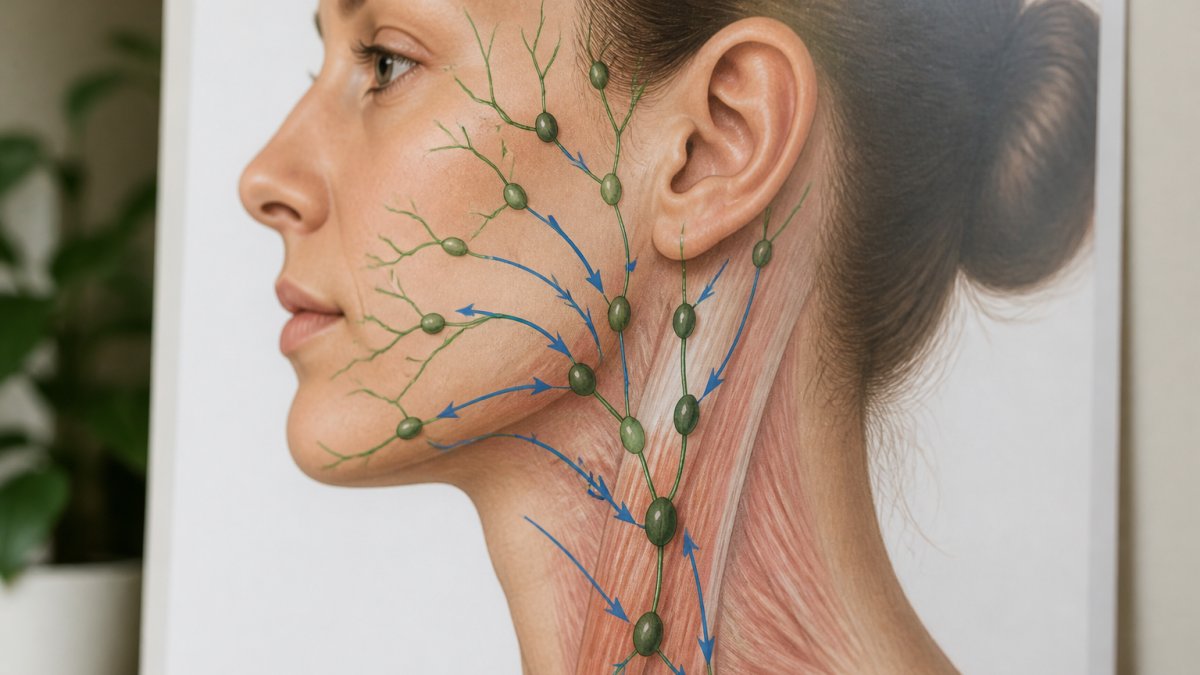
The lymphatic vessels in the face drain downward and outward, toward clusters of lymph nodes near the jaw, behind the ears, and along the neck.
Cleveland Clinic overview of the lymphatic system
Does Facial Lymphatic Drainage Work?
Facial lymphatic drainage may reduce temporary puffiness, but it does not remove fat or detoxify the body. That distinction is the most important thing to understand before you buy a tool.
What the evidence actually supports
It helps to separate two very different bodies of research, because most beauty content blends them together.
Therapeutic manual lymphatic drainage (MLD). This is a credentialed technique performed by trained clinicians, most often for lymphedema, chronic swelling in the arms or legs after lymph node removal, surgery, or radiation.
Cosmetic facial massage and gua sha. Here the evidence is thin and mostly indirect.

So the honest framing is this: the mechanism is plausible, the therapeutic evidence is real but applies to a different intervention, and the cosmetic evidence is limited.
Where facial lymph actually drains
Technique only makes sense once you know the map. The face and scalp drain into a ring of lymph nodes around the head and neck, and the direction of flow is not intuitive, it is not simply "downward."
- Submental and submandibular nodes sit under the jaw and drain the lower lip, chin, floor of the mouth, and the front of the tongue.
- Parotid nodes sit in front of the ear and drain the forehead, eyelids, and outer cheek.
- Postauricular (mastoid) nodes sit behind the ear and drain the scalp and the skin around the ear.
- Occipital nodes sit at the base of the skull and drain the back of the scalp.
- Superficial and deep cervical nodes run down the sides of the neck and collect from all of the above before the fluid returns to the venous system near the collarbone.
That chain explains the standard instruction to finish every stroke by continuing down the neck. Fluid that reaches the jaw but not the cervical chain has not completed the route.
How long the effect lasts
Cosmetic de-puffing is temporary. Most practitioners find that visible improvement fades within a few hours to roughly a day, and it returns fully if the underlying cause, poor sleep, high sodium intake, alcohol, allergies, hormonal fluctuation, is unchanged. There is no credible evidence that repeated facial massage permanently reshapes the jawline, reduces fat, or "sculpts" bone structure. Fat loss requires a caloric deficit; bone structure is fixed. Massage moves fluid.
What it does not do
Claims about "flushing toxins" oversell the technique. Your liver and kidneys handle detoxification; the lymphatic system is a transport network, not a filter. Massage may help move interstitial fluid, but it does not neutralize or eliminate toxins, and no facial routine substitutes for medical care.
Cleveland Clinic overview of the lymphatic system
How to Do Lymphatic Drainage on Your Face
Start with clean hands and a few drops of facial oil so your fingers glide rather than drag. The technique is lighter than you expect: featherweight pressure, slow rhythm, always moving toward the neck.
Calibrate your pressure first
Lymphatic vessels sit in the superficial tissue just under the skin, so deep pressure does not reach them, it compresses them and pushes fluid the wrong way. A useful benchmark: the pressure should be lighter than what you would use to apply moisturizer, closer to the weight of a fingertip resting on a ripe tomato without breaking the skin.
Rhythm matters as much as pressure. Aim for roughly one stroke per second, slow enough that you can feel the skin move with your finger rather than slide under it.
The sequence
- Warm a few drops of oil between your palms and press gently onto your face and neck.
- Using flat fingers, stroke from the center of your chin outward along the jawline to below the ears. This follows the submental and submandibular nodes.
- Sweep from the sides of your nose toward your cheekbones, then toward the ears. This follows the parotid nodes in front of the ear.
- Move from the inner corners of your eyes, along the brow bone, out to your temples, then down in front of the ears. This follows the same parotid chain.
- Finish every stroke by continuing down the sides of your neck to the collarbone, where the cervical chain returns fluid to the venous system.
Keep each stroke slow and repeat 5 to 10 times per zone. More repetitions are not better, the goal is to encourage flow, not to work the tissue.
Hands vs. tools: what actually changes
Tools do not reproduce clinical MLD. They change the surface area, the glide, and the pressure distribution, nothing more. Here is how the common options compare.
| Tool | Pressure profile | Best for | Watch out for |
|---|---|---|---|
| Fingertips | Most precise, easiest to keep light | Learning the sequence, contour areas like the eye | Fatigue; pressure creeps up as you go |
| Gua sha stone | Broad, even, easy to keep flat | Jawline, cheeks, brow; covering more area per stroke | Angling the edge upright turns a sweep into a scrape |
| Facial roller | Very light, hard to over-press | Sensitive or reactive skin; cooling | Small contact area means more passes needed |
| Dry brush | Firmer, exfoliating | Pre-oil prep on the neck and jaw | Too abrasive for the eye area or active breakouts |
A common mistake is pressing too hard with a stone. Gua sha for lymphatic drainage should feel like a gentle sweep, never a scrape. If your skin turns red and stays that way, you are using too much pressure.
Facial Dry Brush for Gentle Exfoliation and Lymphatic Drainage →

Our Sacred Space Sculpting Oil is formulated with jojoba, argan, and carrot seed oils to give tools and fingers enough glide for this kind of work.
How Often to Do Facial Lymphatic Drainage
Most people see the best results from a short daily session, roughly 5 to 10 minutes, rather than a long weekly one. Consistency matters more than duration. A brief morning routine helps with overnight puffiness; an evening session doubles as a wind-down ritual.
If your skin is sensitive or reactive, start with every other day and build up. Overworking the tissue can leave you red or tender, which defeats the purpose. Frequency is about habit, not intensity.
| Frequency | Session Length | Best For |
|---|---|---|
| Daily | 5-10 minutes | Morning puffiness, habit building |
| Every other day | 10 minutes | Sensitive or reactive skin |
| Weekly | 15-20 minutes | Deep relaxation, maintenance |
Gua Sha for Lymphatic Drainage
Gua sha is a traditional scraping technique that uses a smooth, contoured tool to glide across the skin, and many people use it for lymphatic drainage on the face and neck.
Hold the stone flat against your skin at roughly a 15-degree angle, not upright. Our Gua-Sha Stone is made from natural onyx with contoured edges for the jaw, cheeks, and brow.
A common mistake is pressing too hard. Gua sha for lymphatic drainage should feel like a gentle sweep, never a scrape. If your skin turns red and stays that way, you are using too much pressure.
Safety, Contraindications, and When to Seek Medical Care
Facial lymphatic drainage is generally gentle, but it is not appropriate for everyone. Skip it, and check with a clinician, if you have an active skin infection, a rash, recent facial surgery, or a diagnosed lymphatic or circulatory condition.
Puffiness has many causes, including allergies, thyroid conditions, and kidney or heart issues. Persistent or worsening swelling is a reason to see a doctor, not to massage harder.
- No active infection, rash, or broken skin
- No recent facial procedure or surgery
- No diagnosed lymphatic or circulatory condition
- Swelling is mild, symmetrical, and comes and goes
If you can check every box, a gentle routine is reasonable. If not, get medical guidance first.
Conclusion
Learning to read your own face, and to tell ordinary morning puffiness apart from something that needs a doctor, is the real skill here. The science behind lymphatic drainage for face is modest but real: gentle, directional strokes support fluid movement, and consistency is what makes the difference.
At Sacred Space Self-Care, our tools are built for exactly this kind of practice. The Golden Gua Sha stays naturally cool and glides over skin, while the Facial Dry Brush handles gentle exfoliation before your oil. Pair either with our organic Sculpting Oil for a routine you can actually keep.

Shop Now and turn a few quiet minutes into a ritual your skin will notice.
Frequently Asked Questions
Does lymphatic drainage in the face really work?
Yes, facial lymphatic drainage can work to reduce temporary puffiness by encouraging lymph fluid movement. The lymphatic system relies on muscle contractions and manual pressure to circulate lymph, so gentle massage can help move stagnant fluid. However, results are temporary and depend on consistency. It does not detoxify the body or produce permanent fat loss. For best results, use light, directional strokes toward the neck and repeat regularly.
Is face lymphatic drainage worth it?
For many people, facial lymphatic drainage is worth it as a gentle, relaxing practice that may reduce morning puffiness and support skin health. It requires only a few minutes daily and can be done at home with tools like a gua sha stone or facial cupping set. While it won't replace medical treatments for chronic swelling, it offers a low-risk way to enhance your skincare routine and promote a fresher appearance.
How often should I lymphatic drain my face?
You can perform facial lymphatic drainage daily, especially in the morning to reduce overnight puffiness. Start with 5-10 minutes per session using gentle pressure. If you have sensitive skin, begin every other day and adjust based on your skin's response. Consistency matters more than duration, so a short daily routine is more effective than occasional longer sessions.
How long does it take to see results from face lymphatic drainage?
Many people notice a temporary de-puffing effect immediately after a session, lasting a few hours. With regular practice, you may see improved facial contour and reduced morning puffiness within a week. However, these results are not permanent; they fade as lymph fluid redistributes. Consistent daily or every-other-day sessions help maintain the effect.
Can facial lymphatic drainage reduce puffiness?
Yes, facial lymphatic drainage can reduce puffiness by moving excess lymph fluid away from facial tissues. This is especially effective for fluid retention caused by poor sleep, salty meals, or allergies. Techniques like gentle sweeping strokes toward the neck and using a gua sha or facial cupping set can enhance lymph flow. Results are temporary but can be maintained with regular practice.
Does gua sha help with facial lymphatic drainage?
Yes, gua sha is a traditional tool that can support facial lymphatic drainage when used with light, directional strokes. The scraping motion helps move lymph fluid toward drainage pathways in the neck. For best results, apply a facial oil first to reduce friction, and use gentle pressure. Regular gua sha sessions may help reduce puffiness and improve skin appearance.
Can facial massage permanently sculpt your face?
No, facial massage cannot permanently sculpt your face. It can temporarily reduce puffiness and relax tense muscles, giving a more lifted appearance, but it does not change bone structure or remove fat. Any sculpting effect is temporary and lasts hours to a day. For lasting changes, cosmetic procedures are required. Use facial massage as part of a self-care routine for temporary enhancement.
Are there risks or reasons to avoid facial lymphatic drainage?
Facial lymphatic drainage is generally safe for most people when done gently. Avoid it if you have an active skin infection, rash, or recent facial surgery. People with conditions like lymphedema should consult a healthcare provider first. Stop if you experience pain, redness, or worsening swelling. Always use light pressure and clean tools to prevent irritation or infection.


