

Table of Contents
- Why a Morning Self-Care Ritual Matters
- Step 1: Define Your Non-Negotiables and Time Budget
- Step 2: Choose Your Core Practices (Gratitude, Meditation, Movement)
- Step 3: Integrate Skincare and Personal Care Tools
- How to Use Gua Sha in a Morning Routine
- Simple Self-Care Routine for Busy Moms
- Morning Ritual Checklist for Wellness
- Common Mistakes to Avoid When Building Your Ritual
- Frequently Asked Questions
Last Updated: October 9, 2026
Why a Morning Self-Care Ritual Matters
A morning self-care ritual sets the tone for your entire day. It's not luxury or indulgence, it's intentional time that grounds you before the world demands your attention.
When you start with self-care, you're preventing stress rather than fighting it. Your nervous system settles, your skin gets nourished, your mind gets clarity. The alternative is waking up, checking your phone, and running on fumes until bedtime.
The real benefit isn't the glow (though that happens), it's the consistency. A morning ritual trains your brain to prioritize yourself first.
At Sacred Space Self-Care, we've designed tools and resources for exactly this: rituals that are sustainable, not perfect or complicated, just real.

Step 1: Define Your Non-Negotiables and Time Budget
Before you pick practices, be honest about time. This is where most rituals fail.
Don't aim for 60 minutes if you have 15. A 10-minute ritual you actually do beats a 45-minute one you abandon after week two.
Start by answering these questions:
- How much time do you have each morning?
- What time do you need to leave the house?
- Which activities make you feel most grounded?
- What can you realistically do five days a week?
Your non-negotiables are the practices you won't skip, water and stretching, journaling, whatever grounds you. Pick 1-2 maximum, then build around them: 10 minutes gets one core practice plus skincare, 20 adds another element, 30 gives you room to breathe. The schedule matters less than the commitment.
Step 2: Choose Your Core Practices (Gratitude, Meditation, Movement)
Your core practices are the backbone, the things that shift your mindset and energy before anything else happens.
Gratitude and intention setting
Gratitude rewires your brain, it's about noticing what's already working, not forcing positivity. Name three specific things: something you have, something you can do, something you experienced. Not "I'm grateful for my family" but "I'm grateful my daughter laughed at breakfast."
Intention setting comes next. An intention is a direction, not a destination: instead of "I will be productive," try "I will move with purpose today." Write it down, your brain remembers what you write more than what you think.
Mindfulness and breathing exercises
Mindfulness means noticing what's happening right now without judgment, no meditation experience required. Try 4-7-8 breathing: inhale for four counts, hold for seven, exhale for eight, three times. It activates your parasympathetic nervous system. Or notice five things you see, four you can touch, three you hear, two you smell, one you taste. Breathing takes two minutes. It works.
Movement and stretching
Your body has been still for eight hours. Movement wakes it up, and you don't need a workout. Gentle stretching counts: arms overhead, fold forward, twist your spine, touch your toes, holding each 20-30 seconds. Prefer more? Try a 10-minute yoga flow or a walk around your house. The point is to move, not exhaust yourself. Movement increases circulation and signals that the day has started.
Step 3: Integrate Skincare and Personal Care Tools
Skincare becomes part of your ritual when you treat it as a practice, not a chore.
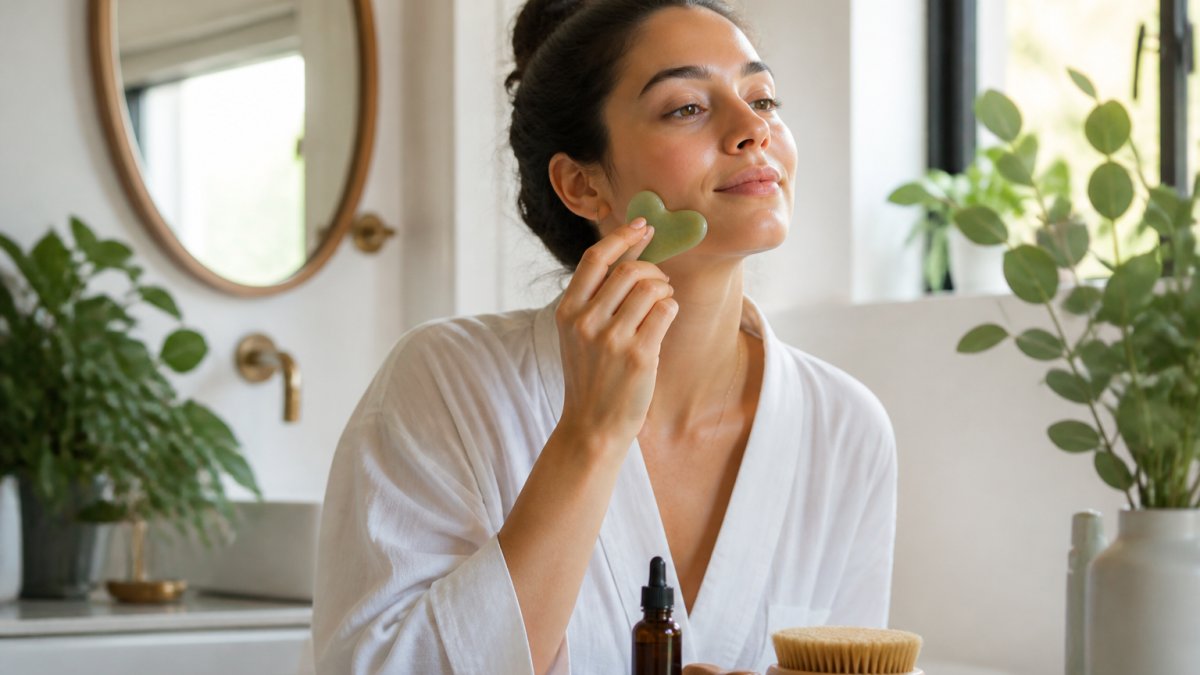
Start with cleansing, cool water or a gentle cleanser wakes your skin and prepares it for what's next. Then apply a nourishing oil. This is where a gua sha stone or facial dry brush makes sense: not magic, just tools that enhance circulation and help products absorb better.
A facial dry brush with gentle bristles exfoliates and promotes lymphatic drainage. Use it 2-3 times weekly on dry skin before cleansing, moving upward from neck and décolletage toward your face. A gua sha stone works best after oil, with gentle upward strokes along jawline, cheekbones, and forehead to promote circulation and reduce puffiness. Sacred Space Self-Care's Facial Dry Brush and Sculpting Oil work together for this reason: the oil provides glide, the brush enhances circulation, and your skin absorbs better. Finish with moisturizer, pat, don't rub. The whole process takes 5-10 minutes. It's not about perfect skin; it's about showing your skin you care.

How to Use Gua Sha in a Morning Routine
Gua sha is a traditional practice turned modern skincare staple: a stone tool used on the face with gentle pressure and upward strokes. Start with clean skin and apply oil or serum, never use gua sha on dry skin. With the curved edge, begin at your jawline and move upward toward your ear with light to medium pressure; this isn't a massage, it's a gentle sculpting motion. Move to your cheekbones, stroking from near your nose outward toward your temples to ease puffiness and promote circulation. Finish at your forehead, moving from the center outward toward your hairline. The whole process takes 3-5 minutes, once or twice weekly. Consistency matters more than intensity.
What does gua sha actually do? It promotes blood flow to your face, so skin cells get more oxygen, puffiness decreases, and your skin looks more vibrant. You're not getting a facelift, you're supporting your skin's natural radiance. Pair it with our Sculpting Oil for optimal glide and results.
Simple Self-Care Routine for Busy Moms
Busy moms need rituals that fit reality, not fantasy.
The Self Care Script Digital Guide and Printable Checklist Schedule →
Your morning might be chaos, kids need breakfast, someone can't find their shoes, you're already behind schedule. A realistic ritual looks like this:
- 2 minutes: Water and stretching while coffee brews
- 3 minutes: Gratitude (write three things while sitting)
- 2 minutes: Skincare (cleanse, apply oil, use gua sha or dry brush)
- 2 minutes: Intention setting (say it out loud or write it down)
That's nine minutes total, before anyone wakes up, or during their breakfast. The key is non-negotiable time. Even five minutes is yours: your nervous system resets, your skin gets nourished, and you start from intention instead of reaction. Some mornings you'll skip the gua sha or only manage water and breathing. That's okay, a five-minute ritual beats no ritual. Start with what you'll actually do, then build.
Morning Ritual Checklist for Wellness
A checklist is only useful if it helps you build something. Use the table below as a menu, then follow the three steps underneath to turn it into a ritual that fits your morning.
| Practice | Time | Frequency | Why It Matters |
|---|---|---|---|
| Water or hydration | 2 min | Daily | Rehydrates after sleep, supports skin and energy |
| Breathing or meditation | 2-5 min | Daily | Downshifts the nervous system, improves focus |
| Gratitude or journaling | 3-5 min | Daily | Shifts attention, builds resilience over time |
| Stretching or movement | 5-10 min | 5x weekly | Increases circulation, loosens overnight stiffness |
| Facial dry brushing | 2-3 min | 2-3x weekly | Exfoliates, supports lymphatic drainage |
| Gua sha or facial massage | 3-5 min | 2-3x weekly | Enhances circulation, reduces puffiness |
| Skincare (cleanse, oil, moisturize) | 5-10 min | Daily | Nourishes skin, supports barrier function |
| Intention setting | 2-3 min | Daily | Directs attention, reduces reactive decision-making |
Step 1: Pick your time budget
Match the ritual to the morning you actually have, not the one you wish you had.
- 5-minute version (rough mornings, new parents, early shifts): Water, three slow breaths, one gratitude, one intention. Skincare only if there's time.
- 15-minute version (most weekdays): Water, 3-minute breathing or meditation, 3 gratitudes, 5-minute stretch, quick cleanse-and-moisturize.
- 30-minute version (open mornings, weekends): Everything above, plus gua sha or dry brushing, a longer journal entry, and a full skincare sequence.
Start at the 5-minute tier for two weeks. Move up only when the shorter version feels automatic.
Step 2: Sequence it around a cue
Order matters less than anchoring. Attach the ritual to something you already do, pouring coffee, feeding the dog, sitting on the edge of the bed, so you're not relying on memory or motivation. A common pattern: hydrate, breathe, move, then care for skin.
Step 3: Check whether it's actually helping
Self-care shouldn't become another performance target. Once a week, rate mood, energy, and mid-morning stress on a 1-5 scale, and note how many mornings you did the ritual. If mood and energy trend up and you're hitting four or more mornings a week, it's working. If you're hitting the ritual but feeling worse, it's too long or the wrong practices, cut it back and rebuild.
Print this. Customize it. Track what you actually do for two weeks. You'll see patterns, and you'll know what to keep.
Common Mistakes to Avoid When Building Your Ritual
Most rituals don't fail from lack of discipline, they fail from predictable, fixable design flaws. Here are the most common, with what works instead.
Mistake 1: Starting too big. You don't need a 60-minute ritual, you need one you'll repeat. Habit research consistently finds new behaviors stick fastest when small and attached to an existing cue (Making health habitual: the psychology of ‘habit-formation’ and general practice).
Mistake 2: Relying on motivation instead of a cue. Motivation fluctuates; cues don't. If your ritual depends on feeling inspired at 6:15 a.m., it collapses on the first bad night of sleep.
Mistake 3: Treating a missed day as a failed ritual. Missing once is noise; missing twice in a row is where routines unravel.
Mistake 4: Copying someone else's ritual. A 5 a.m. cold plunge and 45-minute journaling session work for the person posting about it, not necessarily you.
Mistake 5: Making productivity the goal. If your ritual only counts as successful when you crush your to-do list, you've turned self-care into another performance metric, the fastest way to resent it.
Mistake 6: Never adjusting. What works in January may not work in July, a routine built for a quiet household falls apart during school breaks, caregiving stretches, or a shift change.
Mistake 7: Using tools without intention. A gua sha stone is just a stone without the ritual around it.
Frequently Asked Questions
How long should a morning self-care ritual take to be effective?
A meaningful morning self-care ritual can range from 10 to 45 minutes depending on your schedule and preferences. Even a brief 10-minute routine that includes hydration, one breathing exercise, and a quick skincare practice with a facial dry brush can set a grounded tone for your day. The key is consistency, a shorter ritual you maintain daily outweighs an elaborate one you abandon after a week. Start small, then expand as the habit becomes automatic.
I've tried morning routines before and always quit after a week. How is building a self-care ritual different?
The difference lies in framing and flexibility. A self-care ritual centers on nourishment and intention rather than productivity or perfection. When you focus on how the ritual makes you feel, calmer, more grounded, more connected to your skin, you're more likely to stick with it. Start with just two practices (like gratitude and a facial massage with gua sha), and give yourself permission to adjust based on your energy and schedule. The Self-Care Script Digital Guide includes troubleshooting strategies and a printable checklist to help you stay accountable without guilt.
What holistic tools should I include in a morning self-care ritual?
The most effective tools for a morning ritual are those that promote circulation, calm, and intention. A facial dry brush for lymphatic drainage, a gua sha stone for sculpting and tension release, and organic skincare oil like Sacred Space Sculpting Oil create a complete sensory experience. You can also add face tape for gentle muscle support or facial cupping for enhanced blood flow. The Sacred Space Beauty Bundle includes all these tools plus The Self-Care Script to guide you through their use in a structured daily practice.
How do I know if my morning ritual is actually helping, or if it's just placebo?
Track observable changes over 4-6 weeks: reduced puffiness, improved skin texture, clearer complexion, and better mood or energy upon waking. Keep a simple journal noting how you feel before and after your ritual, this builds awareness of real benefits. Consistency matters; tools like gua sha and dry brushing work through repeated use to support circulation and lymphatic drainage. Pay attention to how your skin looks in natural light and how you feel emotionally. If you're more grounded and your skin appears brighter, the ritual is working.


